From Terroir to Materials Engineering – The Transfiguration of Matter in the EcoVinePanel Project
In 1789, Antoine Lavoisier — the father of modern chemistry — proved that ‘nothing is created, nothing is lost, everything is transformed’. Yet, this transformation can only follow one of three paths: the indifferent, the destructive, or the constructive.
Movecho and Quinta da Alameda envision a future guided solely by constructive paths. Driven by the principle of circular manufacturing, both companies chose to innovate by merging Movecho’s industrial expertise with Alameda’s avant-garde winemaking heritage.
The result is EcoVinePanel, a pioneering initiative that elevates the consortium’s environmental commitment to the absolute forefront of sustainability and technological evolution.
Project Context and Purpose
Year after year, the Dão region generates thousands of tonnes of solid by-products that are largely forgotten and underused. These include the grape stalks, skins, and pips left behind after the pressing season.
This vast, untapped potential remains locked away simply due to a lack of solutions capable of returning these materials to the value chain. Why not, then, develop distinctive circular economy solutions? And why not harness the very best of our knowledge for the benefit of our land?
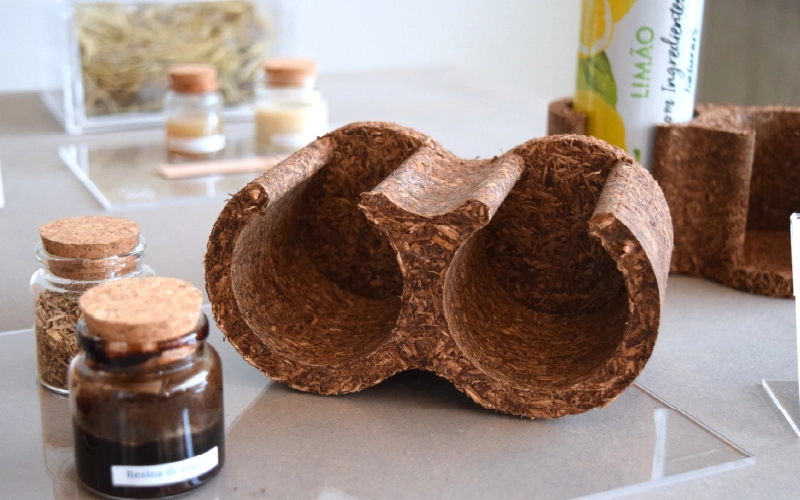
According to Luís Abrantes, CEO of Movecho, the EcoVinePanel project aims precisely to deliver these answers by developing composite panels crafted from upcycled viticultural by-products.
With vast practical applications, these eco-friendly panels can be transformed into a variety of finished products, bringing the natural texture of the vineyard into luxury furniture, organic interior design, or even the very boxes that house our wine.
An Initiative at the Crossroads of Knowing and Doing
Progress accelerates when industry and academia join forces. That is why EcoVinePanel is built upon a rigorous framework of collaboration with leading institutions.
Under the COMPETE 2030 programme, this project pairs the practical, on-the-ground expertise of Movecho and Alameda with the tangible knowledge of ARCP CoLAB and the Polytechnic Institute of Viseu (IPV).
From this continuous exchange emerged the answer to one of the greatest hurdles in processing viticultural waste — the development of entirely bio-based adhesives and resins derived, in turn, from local agroforestry by-products.
This breakthrough allows vineyard waste (and industrial timber remnants) to be bonded without synthetic binders, comfortably passing the most demanding tests for durability, consistency, and technical performance.
EcoVinePanel as a Concrete Commitment to the Dão Region
Wine and the vineyard do not have to follow linear, indifferent, and separate paths after each harvest. Quite the contrary — these journeys should be cyclical, circular, and constructive for the very territory where they exist.
For our region, masterfully reclaiming the resources born from its soil can only be encouraging. For our industry, pioneering new markets can only be encouraging. For Quinta da Alameda, seeing our wine cradled in packaging born from our own vines can only be deeply encouraging.
Beyond mitigating our ecological footprint, EcoVinePanel preserves the memory of the fruit and extends the life of the vines far beyond the vineyard. We interweave the culture of wine with eco-efficiency, aesthetic refinement, and engineering rigour. And we humbly correct Lavoisier — much is indeed created, dear master chemist, but to do so, one must first know how to transform.


