Decanting wine: when and why is it worthwhile?
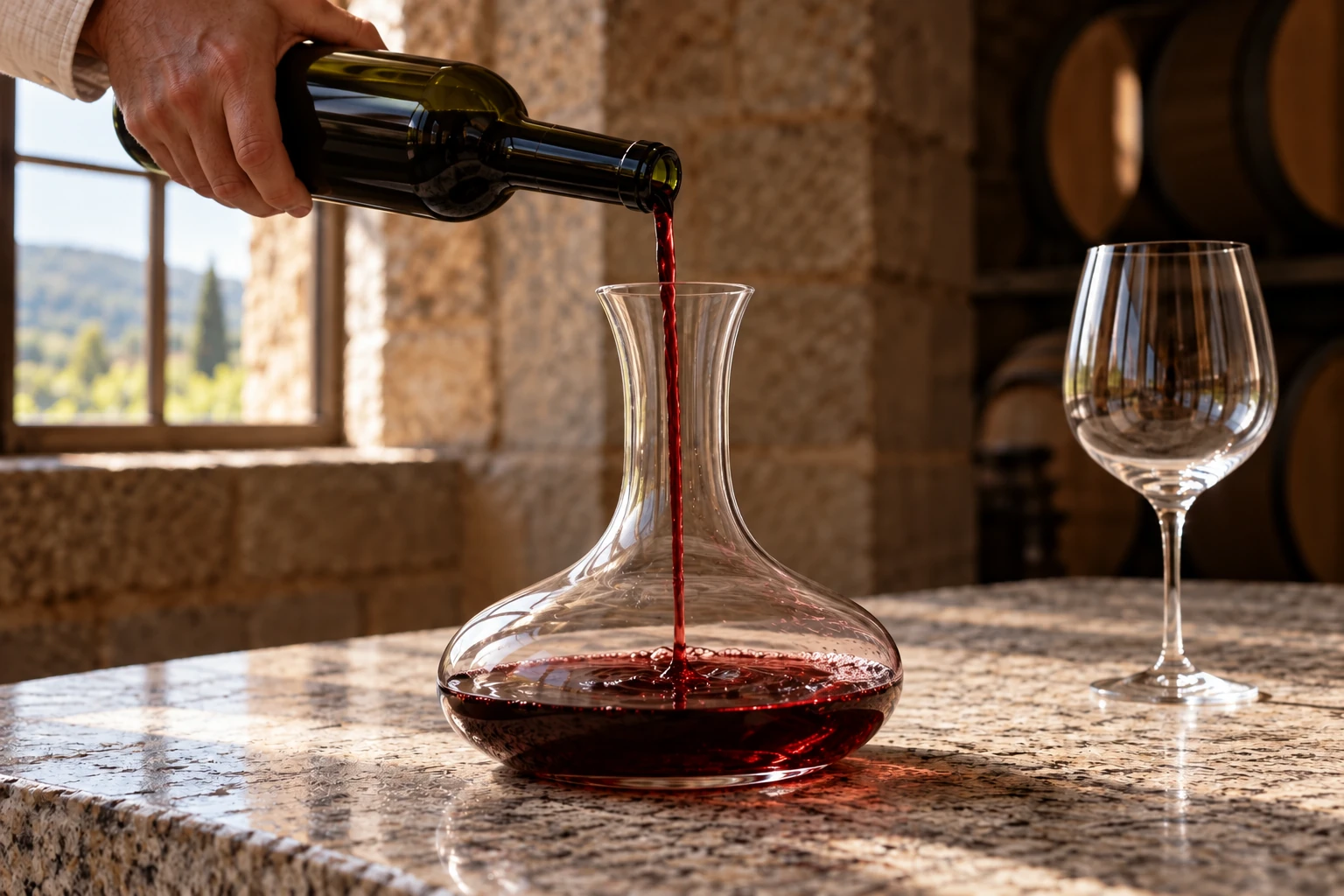
Decanting wine separates the liquid from its sediment. A decanter can also expose the wine to air, but only when a taste confirms that this benefits it. It is most useful for wines with sediment or certain young wines that seem closed. However, older and more delicate wines need particular care.
In a musical score, a fermata tells the conductor or performer: ‘hold this note or rest for as long as you think appropriate’. A decanter poses much the same question at a wine tasting: how long should we wait for this particular wine?
As in music, the answer calls for interpretation: one wine may gain clarity after time in a decanter; another may lose precisely the delicacy we hoped to find.
So before you choose a vessel or consult the clock, first consider what that particular bottle needs.
Are decanting and aerating wine the same thing?
Although the same action can achieve both, they serve different purposes.
Strictly speaking, to decant is to transfer wine to another vessel without disturbing its sediment. To aerate is to increase its contact with air. A wine may need the first operation yet tolerate prolonged exposure to oxygen very poorly.
The question of sediment in wine
A natural deposit can form in red wines that have aged in bottle or undergone little filtration. Sediment alone does not mean that a wine has spoiled.
However, it can introduce bitterness or a rough sensation on the palate. Decanting helps you enjoy the wine without that interference.
The question of wine aeration
Aeration has a different aim. It can make certain aromas more apparent and soften some unwelcome reductive notes. But reduction involves several compounds, and they do not all respond to air in the same way. A decanter is therefore no universal remedy.
When is it worth decanting a wine?
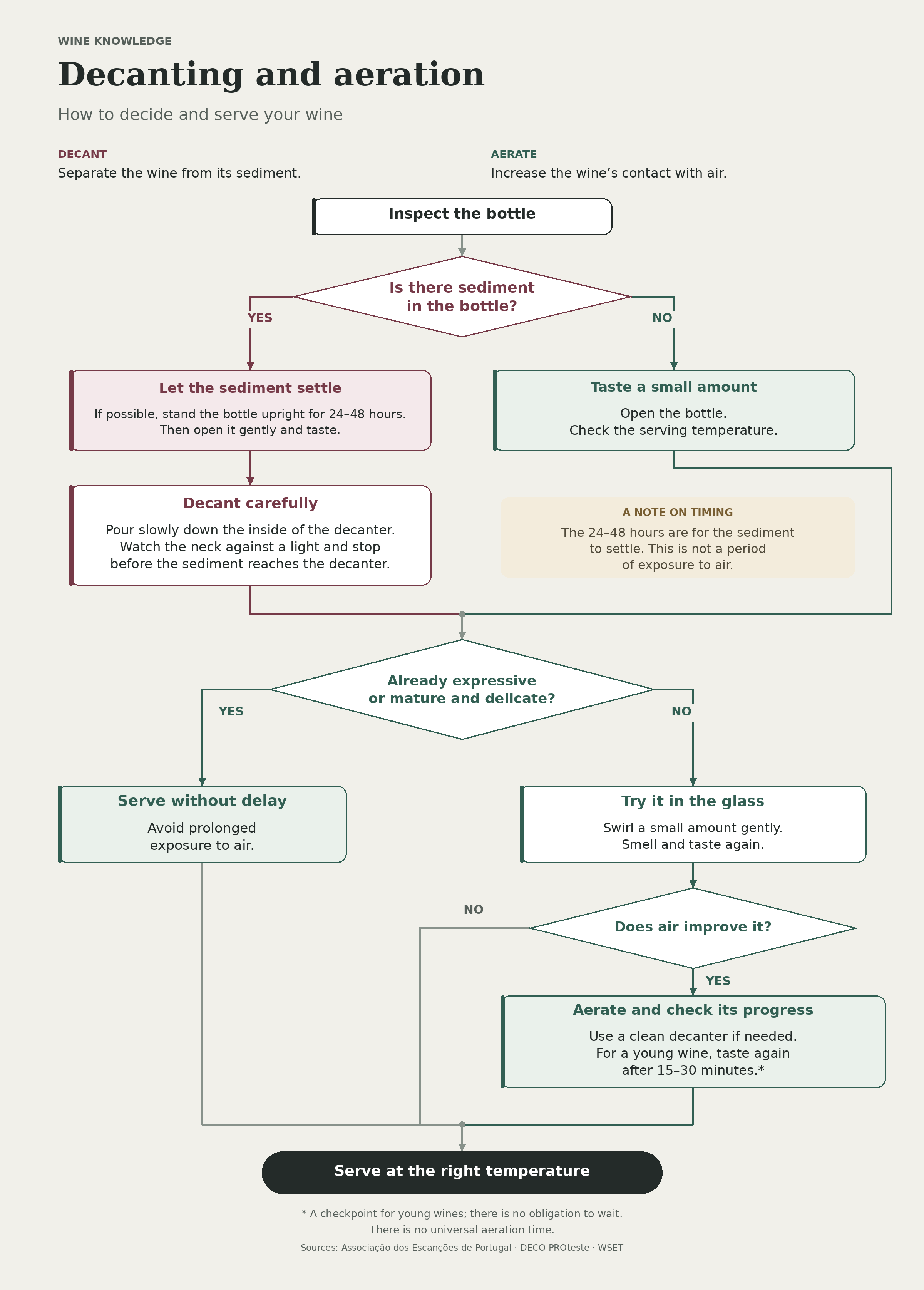
Check for sediment and taste a small amount before you decide. If the wine already tastes good and its aromas are clearly defined, you can serve it straight from the bottle. Price or age alone does not make decanting necessary. Nor does a reserva designation.
For a wine without sediment, try a little in the glass before you aerate it: swirl gently and smell and taste again. If it clearly improves, you can consider aeration for the rest of the bottle. If it becomes less expressive, avoid exposing the entire bottle to more air.
| What you find in the bottle or glass | How to serve the wine |
|---|---|
| Sediment could reach the glasses | Decant carefully to separate the solids. For an old and fragile wine, do so shortly before service. |
| A young wine seems closed and improves with air in the glass | Consider aeration and check how the wine develops. |
| An old wine already has delicate and well-defined aromas | Avoid prolonged aeration. If there is no significant sediment, serve it from the bottle. |
| The wine is clear, expressive and balanced | Serve it directly; a decanter is unnecessary. |
Every decision should start with the wine’s condition rather than a rigid classification by grape variety or other factors. Why? Because two bottles with the same label may have had different storage histories. A taste remains the best starting point for the right approach to service.
How long should wine stay in a decanter?
There is no universal decanting time that suits every wine. For example, a mature wine may need no more than a transfer immediately before service to separate its sediment.
However, a young and austere red may need more time to breathe. Infovini suggests around two hours for young reds; adjust that guideline by taste and take particular care with more delicate wines.
For a young wine that has already shown a positive response to air, a practical approach is to check it after 15 to 30 minutes. If it continues to improve, taste again at similar intervals. But remember: these are checkpoints rather than a compulsory wait or a guarantee of good results.
Serve the wine once it reaches an expression you enjoy. However, if the aromas lose definition or the fruit seems less vibrant, a longer wait is unlikely to be the best answer.
Do not apply this waiting routine to an old and fragile wine: follow its progress from the outset and aim to serve it soon after opening.
Also maintain a serving temperature that suits the wine. A decanter on a warm table can change the experience before aeration has done its work. The producer’s advice should always take precedence over vague instructions to ‘serve at room temperature’.
How do you decant wine with sediment, step by step?
Prepare a light source and a clean transparent vessel with no residual odours. For a delicate wine, keep the surface exposed to air as small as practicable; a very broad decanter is primarily suited to aeration. A small torch helps you see the sediment without the heat of a candle flame.
1. Let the sediment settle. If you can plan ahead, stand the bottle upright for 24 to 48 hours. The aim is to collect the particles at the bottom. If sediment is still suspended, the clock is no substitute for observation.
2. Open the bottle gently. Remove the capsule and cork with care. Clean the neck and check that the decanter has no detergent residue or other odours.
3. Pour slowly in one continuous movement. Let the wine run down the inside of the decanter. The handbook from the Associação dos Escanções de Portugal recommends minimal agitation.
4. Watch the neck against the light. Stop the transfer as sediment approaches this point. Leave enough wine in the bottle to hold back the solids. An attempt to save the last drop can undo all your previous care.
5. Adapt service to the wine. Serve an old and fragile wine soon after decanting. If you also want to aerate a young wine, keep track of its progress by taste.
If you only want to aerate a wine without sediment, there is no need for the bottle to stand for 24 to 48 hours beforehand. That time is for the solids to settle; it is not a period of exposure to air.
Do Dão wines need decanting?
Assess Dão wines bottle by bottle. The region produces structured reds with ageing potential as well as wines that are expressive as soon as the cork is drawn. Touriga Nacional and firm tannins help explain a wine’s character, but should never dictate its aeration time.
With a young Dão red, see whether air brings greater aromatic definition. With a mature red, start with the sediment and the delicacy of the wine as a whole. Its perceived structure matters more than an automatic rule tied to the vintage.
White wines deserve the same attention. The Dão Regional Wine Commission highlights Encruzado’s ageing potential. This calls for careful assessment of a mature white without making decanting compulsory. One Encruzado may gain expression with a little air; another may reveal itself fully in the glass.
Before you aerate a reticent white, check that it is not simply too cold. An excessively low temperature can mask aromas and lead to a hasty diagnosis. If you choose a decanter, keep the wine cool throughout service.
For Quinta da Alameda wines, advice should reflect both the vintage and the condition of the individual bottle. A closer look at the role of tannins and the character of Encruzado can help explain that decision. Good service begins with attention to these differences and ends in the glass.
Which decanting mistakes should you avoid?
Do not turn a useful technique into a compulsory ritual. A wine that already shows well may need no intervention. Also avoid disturbing sediment or waiting too long once a wine’s expression begins to fade.
Another misconception is that a decanter can reproduce years in a cellar. Bottle ageing involves changes that brief exposure to air cannot achieve. If the wine seems less astringent, describe this as a sensory impression rather than evidence that its tannins have disappeared.
Nor is decanting a reliable remedy for an oxidised or corked wine. Cork taint can resemble damp cardboard and is frequently associated with TCA, a compound that affects aroma. Do not confuse it with small pieces of cork in the liquid.
Frequently asked questions about decanting wine
Can you decant white wine?
Yes, if there is sediment to remove or a specific reason to aerate it. Some white wines develop tartrate crystals: a natural deposit that can stay behind in the bottle. Most whites do not need decanting. Keep any intervention brief for delicate examples and always check the temperature.
How can you aerate wine without a decanter?
For an initial trial, a suitable glass and a gentle swirl are enough. If you decide to aerate a larger amount, use a clean glass jug with no residual odours. To separate sediment, pour with the same care as you would into a decanter. An accessory that simply mixes air into wine does not itself remove solids.
Is it enough to open the bottle and wait?
An open bottle allows some contact with air, but the effect depends on the exposed surface and the wine. To improve aromatic expression, an earlier opening can be an alternative to decanting. An initial taste in the glass reveals the wine’s response and helps you decide whether anything more is needed.
Can you leave wine in a decanter overnight?
A decanter is intended for service and is not the best place to keep leftover wine. Transfer the remainder to a clean bottle of a suitable size. Close it and put it in the fridge even if the wine is red. The cold slows oxidation, but cannot restore aromas already lost.
The right moment to serve
A fermata asks the conductor to sustain a musical note and recognise the moment to release it. With wine, that judgement belongs to whoever serves it. Once the sediment has been separated or the wine has had the air it needs, the time comes to put down the decanter and raise the glass. As in music, the wait fulfils its purpose only when the wine’s notes are well interpreted.
Sources and further reading
- Associação dos Escanções de Portugal — Manual de Elaboração de Carta de Vinhos (PDF)
- Infovini — Decantação
- WSET — Frequently asked questions about serving and decanting wine
- Australian Wine Research Institute — Wine flavours, faults and taints
- CVR Dão — Castas
- La Revue du vin de France — Comment carafer un vin ?
- WSET — Common wine faults and how to spot them
- WSET — The best ways to keep wine fresh
About the winemaker

Patrícia Santos is the winemaker at Quinta da Alameda. She graduated in Oenology from UTAD (University of Trás-os-Montes and Alto Douro) in 2001 and developed her skills under Anselmo Mendes. Her professional experience spans Dão as well as Bairrada and Beira Interior. She has also worked in Arribes in Spain.


